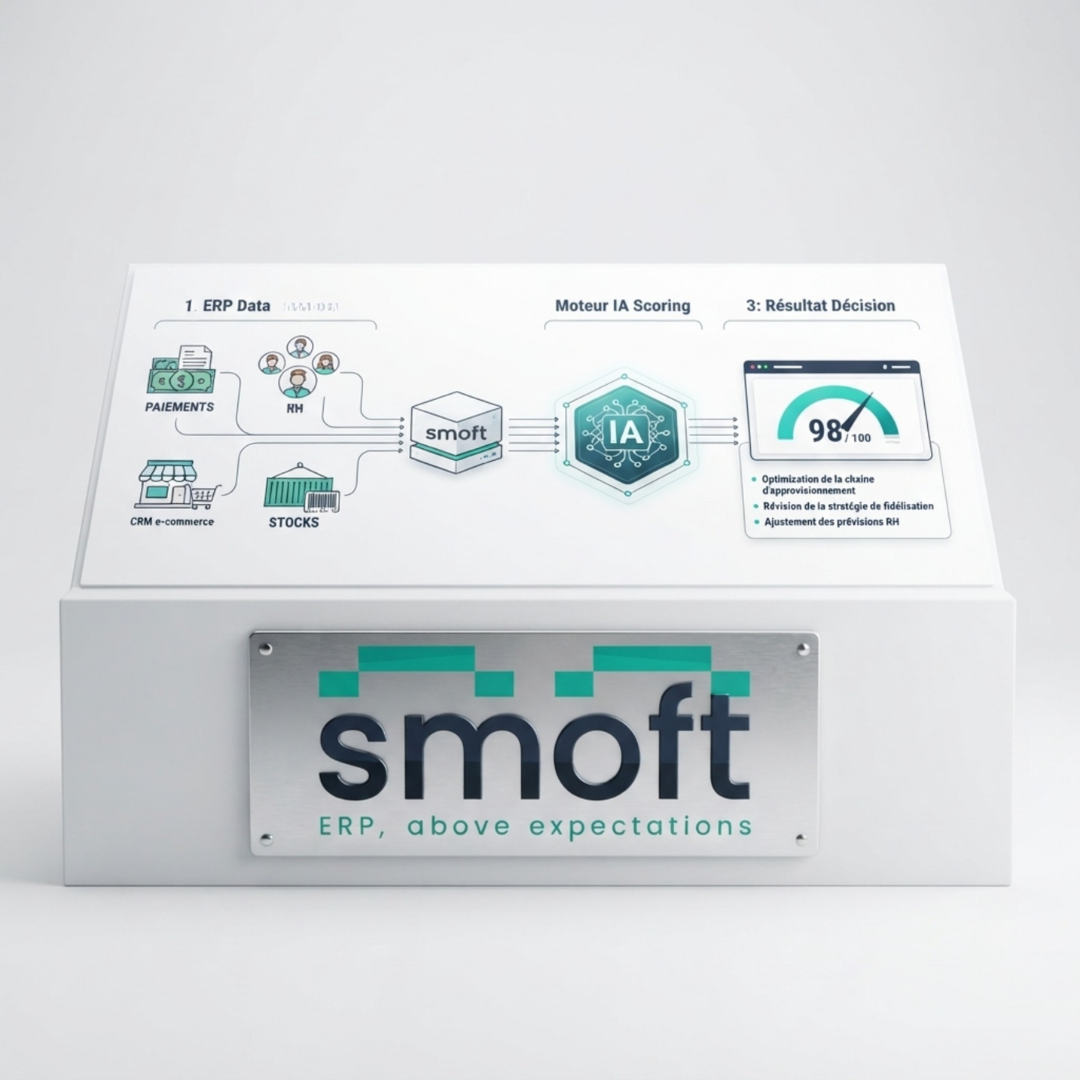
An AI scoring agent in an SME ERP automatically assigns a score out of 100 to each business entity — customer, supplier, employee, or prospect — by combining up to 35 key performance indicators across 8 areas of analysis. This dynamic scoring, updated in real time, transforms raw ERP data into immediately actionable decision support.
What Is an AI Scoring Agent in an ERP?
Definition and How It Works
The Scoring Agent is one of the 8 agents in the IASMO suite by SMOFT ERP. It connects to ERP data in read-only mode (without ever modifying it) and produces a structured score for any entity registered in the system.
Its core principle is: the calculation engine produces the numbers; AI explains what they mean in natural language.
This separation is deliberate and crucial. It ensures two qualities that traditional AI systems do not always combine: numerical accuracy (calculations are deterministic and based on actual data) and human clarity (results are explained in French or Arabic, with concrete recommendations).
The 8 Areas of Analysis Covered
The Scoring Agent analyzes ERP entities across 8 distinct areas:
Business — overall commercial performance, revenue growth, profitability.
Customer Relationship (CRM) — customer retention, churn rate, satisfaction, customer payment delays.
Supplier Relationship (SRM) — delivery reliability, compliance, quality, commercial terms.
Human Resources — productivity, absenteeism, turnover, burnout risk.
Stock — inventory turnover, stockouts, overstock, service level.
Production — OEE, scrap rate, adherence to manufacturing deadlines.
Risk — financial exposure, customer concentration, supplier dependency.
Recruitment — CV / job matching, comparative candidate analysis.
How Does Customer Scoring Work?
The 35 KPIs Analyzed
For a customer, the Scoring Agent automatically combines indicators from several ERP modules:
Payment indicators: average payment time, frequency of late payments, outstanding unpaid amounts, on-time payment rate.
Commercial indicators: purchase frequency, average order value, 12-month revenue trend, quote response rate.
Satisfaction indicators: product return rate, frequency of disputes, complaint resolution time.
Risk indicators: share of total revenue generated by this customer (dependency), historical behavior during periods of economic pressure.
What the Score Actually Tells You
A customer with a score of 82/100 in the CRM area and 45/100 in the financial risk area tells you something specific: the commercial relationship is excellent, but your level of dependency on this customer or their recent payment profile requires attention.
The agent does not simply display these figures. It provides a natural-language assessment, identifies the 2 to 3 indicators having the most negative impact on the score, and proposes priority actions along with their level of urgency.
How Does Supplier Scoring Work?
Supplier Reliability Indicators
For a supplier, the scoring measures:
Logistics reliability: percentage of deliveries made within the contractual timeframe, actual delivery time versus the announced lead time, frequency of partial deliveries.
Quality compliance: rate of compliant deliveries (quantities, references, condition), frequency of non-conformities, dispute resolution time.
Commercial terms: price stability, compliance with negotiated terms, flexibility in the event of urgent orders.
A supplier whose reliability score declines for 3 consecutive months is proactively identified by the agent — before the situation impacts your production chain or customer delivery times.
CV Scoring for Recruitment
CV / Job Description Matching
The Scoring Agent includes a candidate-to-position matching feature: it compares the content of a CV (automatically extracted by the SmartOCR agent) with a job description configured in the HR module and produces a justified matching score.
This score does not replace a recruiter's human assessment. It helps prioritize applications for review when dealing with a large volume of candidates — while also making part of the initial screening process more objective.
FAQ — Frequently Asked Questions About the AI Scoring Agent for SME ERP
Q1: What is an AI Scoring Agent in an SME ERP?
It is an AI agent that automatically scores customers, suppliers, employees, and prospects out of 100 by combining up to 35 KPIs across 8 areas of analysis, and presents the results in natural language with actionable recommendations.
Q2: Can the Scoring Agent make calculation errors?
No. The calculation engine is deterministic: the same data always produces the same result. AI is only used to explain and contextualize the results — not to calculate them. This architecture ensures score reliability.
Q3: Does the Scoring Agent modify ERP data?
No. The Scoring Agent operates in read-only mode. It does not create, modify, or delete any data in the ERP. It analyzes and recommends — actions remain at the user's discretion.
Q4: Can users ask the Scoring Agent questions in natural language?
Yes. The agent understands questions in French, Arabic, or English. Questions such as "How is our main customer doing?" or "Which is our least reliable supplier?" are valid queries.
Q5: How often are scores updated?
Scores are calculated dynamically from the ERP's real-time data. Every new transaction, payment, or delivery recorded in the ERP can affect the scores of the relevant entities.
*The Scoring Agent is part of the IASMO suite by SMOFT ERP — available on the Premium plan. Discover it now : book a demo